chaos-vs-system
When business processes live only in people's heads: why it slows growth and how to fix it
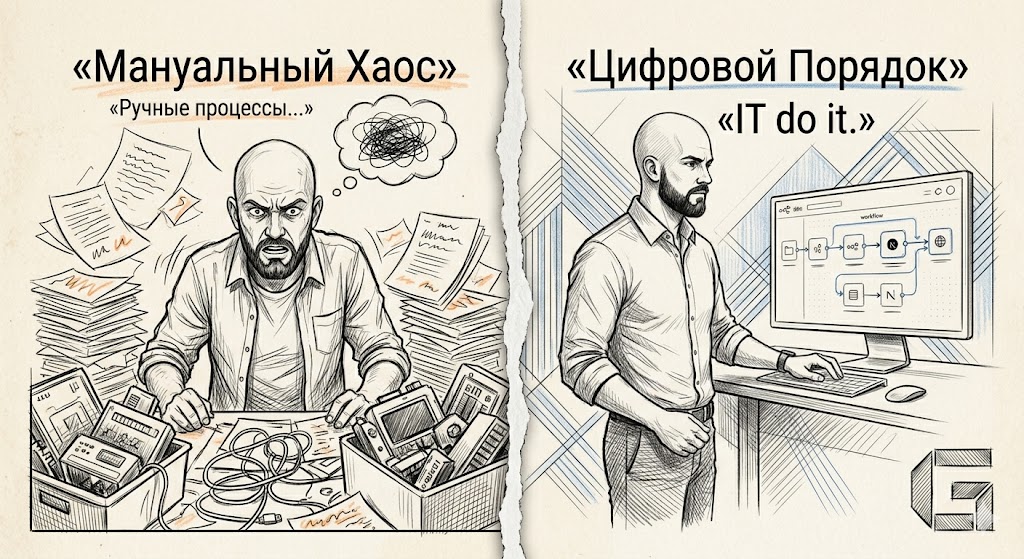
Most companies run on verbal agreements and trust. Processes exist, people get things done somehow — but nothing is written down. Whatever regulations were written years ago are outdated and quietly ignored.
Without documented processes, everyone handles the same task differently. Departments talk past each other. There's no single source of truth. Numbers are tracked by feel. New hires spend months figuring out who knows what. People burn out working around chaos instead of through a system.
None of that shows up cleanly in a budget, but it costs money.
What this actually looks like
A wooden puzzle manufacturer, around 120 employees, export-oriented. Production costs were tracked loosely. Part of the product range was selling at a loss — nobody saw it because the numbers diverged from reality by 26% on materials alone.
After mapping the production processes, the picture became clear. Unprofitable lines were cut. Capacity freed up by 33% and was filled with profitable orders. Finished goods inventory dropped by 60%.
The money was there the whole time. It just wasn't visible.
How to fix it: AS IS → TO BE
Start by recording how processes actually work — not how they're supposed to work on paper. This is AS IS mapping.
Talk to your employees, especially the most effective ones. Record the actual steps, tools, and decision rules they use. Find where management's assumptions diverge from what the team does day to day.
Then design TO BE: how things should work. That distance between the two is where most of the problems live.
Something that works well in practice: find your best performer, study exactly how they do the job, and map it. That alone beats having no documentation — or a handbook nobody reads.
What changes
When processes are written down and people actually trust them, a lot of the background noise goes away. Fewer back-and-forth questions. Fewer approval loops. New employees get up to speed in weeks instead of months. Managers can make real decisions instead of explaining the same thing over and over.
On automation
A lot of companies buy software hoping it'll fix their process problems. It won't. Any CRM, ERP, or document system just runs whatever logic you give it — so if your process is broken or missing, the software locks it in. Get the processes right first. Automation becomes much simpler after that, and implementation costs a fraction of what it would otherwise.
Who I am
20+ years in IT — on both sides, at different points in my career. I worked in-house at manufacturing companies: set requirements for contractors, managed delivery, accepted work, pushed back when needed. I also founded an IT services company where I was the one doing the work — support, implementation, development, defending solutions in front of clients.
I know what each side actually wants. And I've seen where they stop hearing each other.
Formats: consultation, AS IS process audit, full project delivery, Fractional CTO.
First step
Fill out the form or reach out — we'll talk through your situation, no strings attached.